
What Went Off the Rails With Human-Centered Design?

What if the feel-good philosophy of Human-Centered Design is a dangerous myth? One that allows companies to weaponize empathy, scrub criticism, and manipulate users into accepting broken systems. The truth is, focusing on the human alone is a trap. Real design power exists in the ruthless intersection of human desire and the cold, hard systems that govern our world.
- The Weaponization of Empathy
How “user-centric” language became a smokescreen for surveillance and control. - The Systemic Blind Spot
Why designing for human emotion without the system’s architecture is building on quicksand. - The Integrity Mandate
To build ethically, we must master relations between psychology, code and law.
Human-Centered Design sounds lovely. But it’s a fantasy. We don’t exist in a vacuum – we’re entangled in algorithms, corporate policies, and economic engines that dictate behavior. Praising “empathy” while ignoring the underlying system isn’t just naive, it’s professional negligence. This disconnect has turned a noble ideal into a manipulative tool, letting everyone slap a friendly face on toxic products and sue critics into silence.
Human Feelings vs. Machine Logic
Human-Centered Design (HCD)
HCD is the art of the interface. It thrives on empathy, intuition, and frictionless moments. Its mission is noble: make things usable, useful, and desirable. From Donald Norman’s principles to today’s UX rituals, it teaches us to see through the user’s eyes. But alone, it’s just a polished surface. It asks “how does this feel?” but often ignores the more critical question: “what machine does this feed?“
System Design (SD)
System Design is the architecture of reality. It’s the relentless logic of data flows, business rules, network protocols, and security layers. It’s what keeps platforms from collapsing under traffic and ensures (or weaponizes) information control. When HCD operates in ignorance of this engine, it becomes complicit. It applies “lipstick on a pig“, creating delightful experiences that front for exploitative or broken machinery.
How “Empathy” Became The Weapon
This is where your most provocative insight hits home. Human-Centered Design’s tools haven’t been abandoned, they’ve been corrupted.
Corporations didn’t discard the language of empathy – they hijacked it. “User needs” now mask data harvesting. “Frictionless journeys” enable addictive loops. This is the dark translation of HCD into a manipulative service layer.
- The “Nudge” Turned Toxic
Behavioral psychology, meant to guide towards better choices, now instills FOMO, anxiety, and shame to drive engagement. - The “Sludge” Factory
Dark patterns – those endless cancellation hoops, hidden fees – are systemic traps designed by Business and Behavioral Design subsystems to imprison users. - The Legal Muzzle
The ultimate system override uses legal and security subsystems to threaten critics, scrub reviews, and silence dissent. This isn’t poor design, it’s a calculated architecture of intimidation.
The result is market where bad actors use superior system-aware design to suffocate better brands and their quality products and services, or to push quality products and services of their competitors off the market in order to replace them with their low quality products and services under premium prices – market collapse (lemon market).
Ethical Design
The solution isn’t to abandon human focus. It’s to expand design sovereignty.
Human-Centered Design is not a standalone discipline. It is one critical subsystem within a greater whole. Treating it as the main event is like perfecting a car’s cupholder while the engine is on fire.
The modern designer must be a generalist, a systems thinker. He or she (designer) must comprehend:
- The Human Subsystem (HCD)
Emotion, intuition, usability. - The Behavioral Subsystem
The psychology of persuasion and choice. - The Technical Subsystem
Software, data, and algorithm logic. - The Structural Subsystem
Business rules, legal frameworks, profit motives.
Good design happens at the command center (cybernetics), where all these systems and sub-systems are visible and balanced.
The Integrity Mandate
The way forward requires integrating this human focus with the broader stack it operates within: the behavioral models, the business rules, the technical architecture. The designer’s critical role is to navigate this entire spectrum, ensuring coherence and responsibility from the user interface to the underlying logic.
The essential question evolves from “Is this usable?” to “Is this entire construct sound?” Does the surface experience honestly reflect the system’s purpose and integrity? If not, the design has failed its core function, no matter how elegant it appears.
At studio Simple we believe in full-stack integrity – where human empathy is hardened by systemic logic, building customer relationships designed to last.
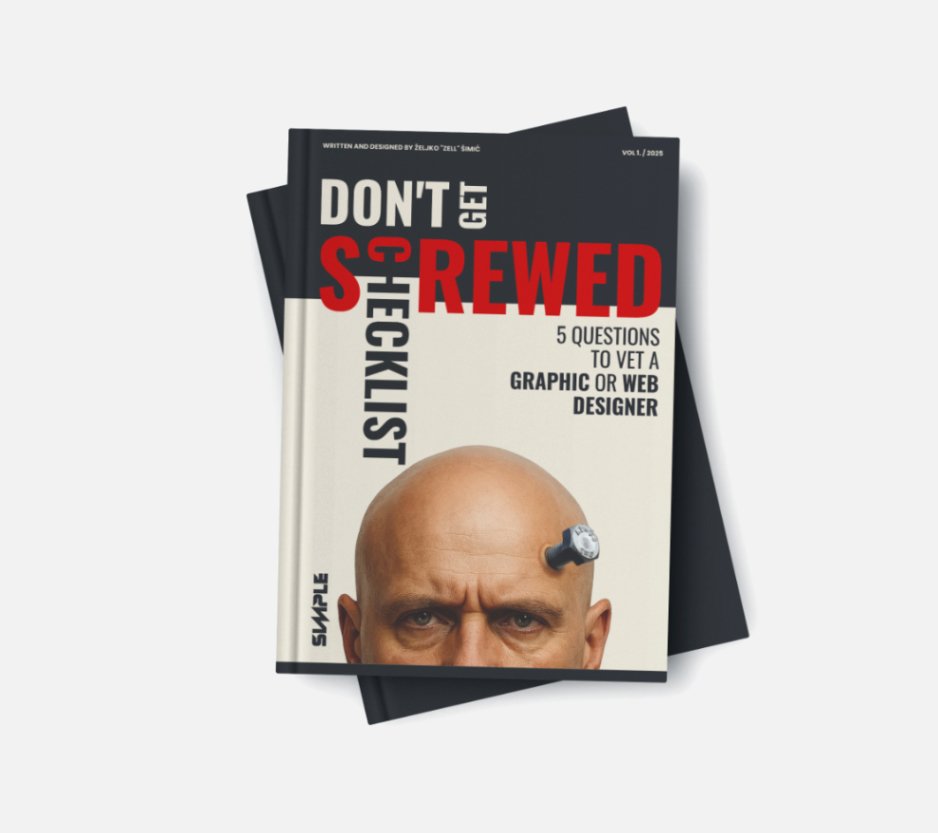
Avoid Mistakes: Get Your Free Pre-Design Checklist
Before you invest in a new logo or brand identity, use my free checklist to pressure-test your strategy. Avoid costly misunderstandings.
Credits & Disclaimer: The purpose of this article is to educate, inform, criticise, and comment on directions the design industry has taken. For more visit Terms and Conditions page.